Ciphernafit
Cipher Edition
Cipher Edition
Couldn't load pickup availability
- 📦 Digital file available after purchase
- 🔄 Long-term availability
- 🛡️ Secure checkout
- 🔄 Content updated in 2026
Self-paced learning overview
1. Problem Statement
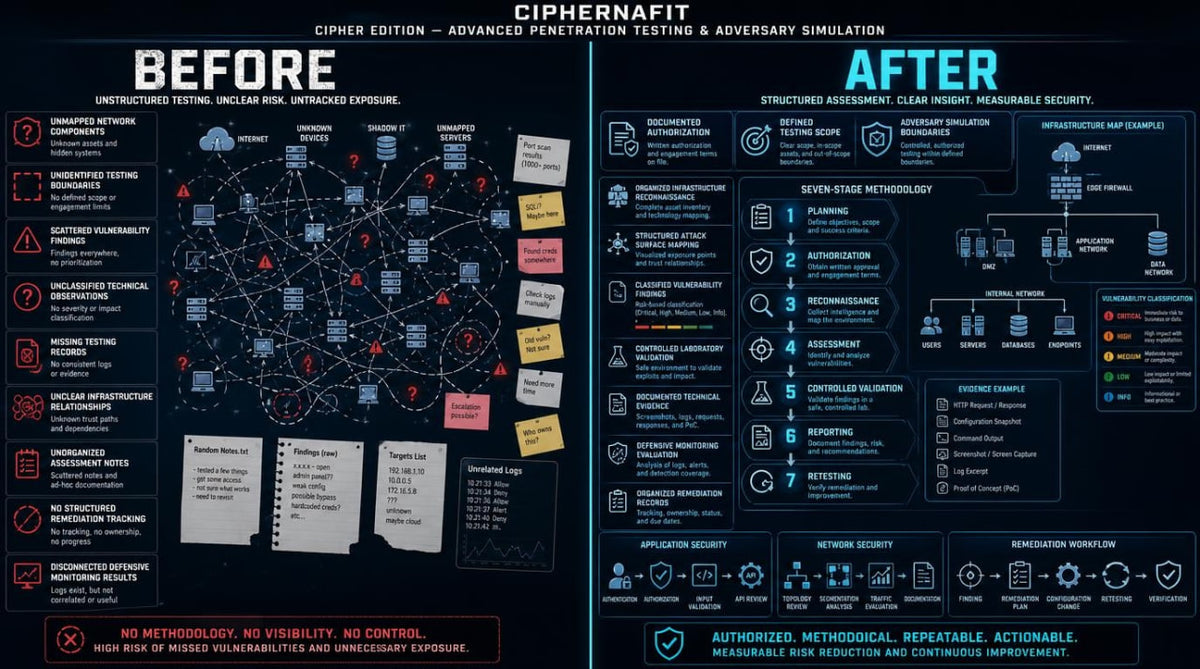
Comprehensive cybersecurity assessment requires an understanding of how individual vulnerabilities can interact and affect an entire digital infrastructure. Isolated examinations of individual components do not always reveal complex chains of risks involving network architecture, user privileges, configurations, and system interactions. Without a structured testing methodology, it becomes difficult to reproduce realistic threat scenarios, evaluate their impact, and prepare well-supported recommendations for addressing identified weaknesses.
2. Solution
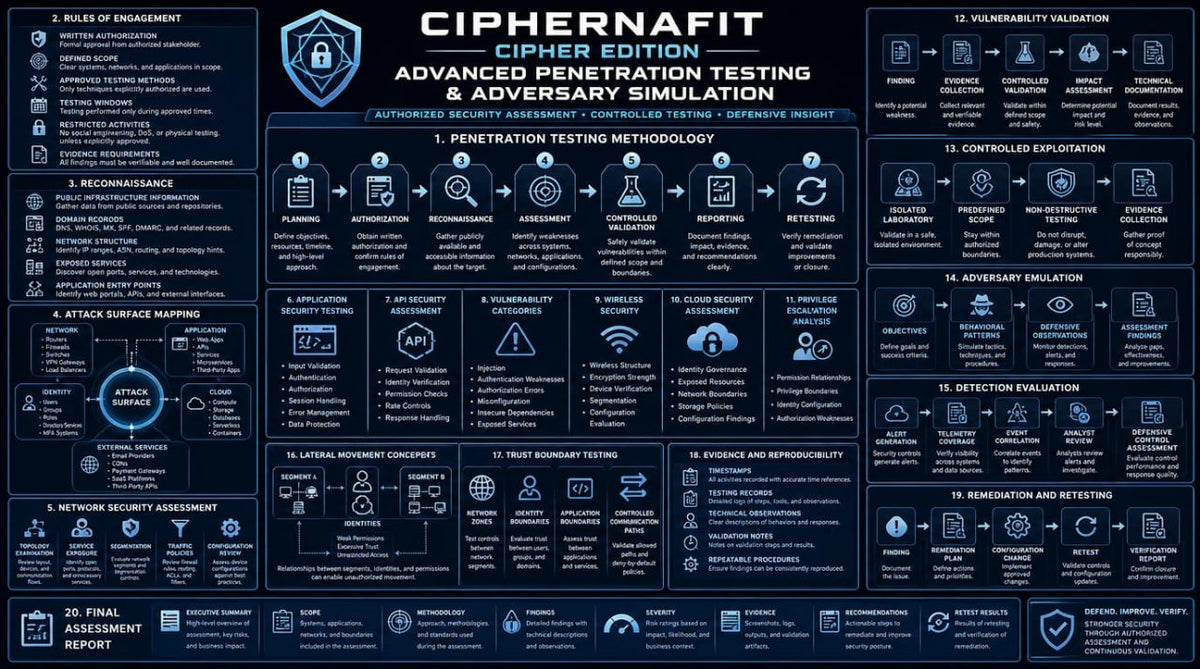
Cipher Edition presents a comprehensive methodology for authorized security testing and adversary simulation within specially prepared environments. The learning materials examine infrastructure reconnaissance, attack surface analysis, network and application assessment, privilege investigation, and the evaluation of possible incident progression paths. Dedicated sections cover controlled attack simulation, defensive mechanism evaluation, technical evidence documentation, and security retesting after vulnerability remediation.
3. What's Inside
-
Module 1: Advanced Penetration Testing Methodology
-
Module 2: Authorization Scope and Rules of Engagement
-
Module 3: Reconnaissance and Information Gathering
-
Module 4: Attack Surface Discovery and Mapping
-
Module 5: Network Infrastructure Assessment
-
Module 6: Web Application Security Testing
-
Module 7: API Security Assessment
-
Module 8: Authentication and Authorization Testing
-
Module 9: Input Validation and Injection Vulnerability Analysis
-
Module 10: Security Configuration and Exposure Assessment
-
Module 11: Wireless Infrastructure Security Testing
-
Module 12: Cloud Environment Security Assessment
-
Module 13: Identity and Privilege Escalation Analysis
-
Module 14: Vulnerability Validation and Exploitability Assessment
-
Module 15: Controlled Exploitation and Laboratory Procedures
-
Module 16: Adversary Emulation and Attack Scenario Design
-
Module 17: Security Detection and Monitoring Evaluation
-
Module 18: Lateral Movement Concepts and Defensive Analysis
-
Module 19: Network Segmentation and Trust Boundary Testing
-
Module 20: Technical Evidence Collection and Reproducibility
-
Module 21: Remediation Verification and Security Retesting
-
Module 22: Penetration Testing Reports and Technical Communication
-
Module 23: Integrated Security Assessment Laboratory
4. Who Is This For?
Suitable if you:
✅ Already have substantial knowledge of network security, system architecture, and secure software development.
✅ Want to study authorized penetration testing methodologies in greater depth.
✅ Are interested in investigating complex vulnerabilities and relationships between infrastructure components.
✅ Intend to study privilege assessment, identity management, and trust boundaries.
✅ Want to explore security testing methods for web applications and APIs.
✅ Are interested in simulating adversary behavior in controlled laboratory environments.
✅ Want to understand how threat detection and monitoring systems are evaluated.
✅ Intend to develop technical reporting skills for comprehensive security assessments.
✅ Are looking for an advanced educational program covering digital infrastructure security testing.
Not suitable if you:
❌ Do not yet have a fundamental understanding of computer networking and information security.
❌ Are looking exclusively for a theoretical introduction to cybersecurity.
❌ Expect instructions for unauthorized intrusion into other people's systems.
❌ Intend to use learning methods to disrupt third-party infrastructure.
❌ Are looking exclusively for digital forensics training without studying security testing methodologies.
5. What You'll Learn
After studying Cipher Edition, you will be able to:
-
Explain comprehensive security assessment methodologies.
-
Define authorized assessment boundaries and establish testing rules.
-
Apply structured approaches to technical information gathering.
-
Analyze attack surfaces and relationships between infrastructure components.
-
Examine network architecture from a vulnerability assessment perspective.
-
Understand web application security testing methodologies.
-
Analyze APIs and communication mechanisms between software components.
-
Evaluate authentication and authorization logic.
-
Recognize risks associated with input handling and injection vulnerabilities.
-
Assess system configurations and identify unintended exposed components.
-
Analyze wireless infrastructure security.
-
Examine cloud environment configurations from an information security perspective.
-
Understand privilege escalation mechanisms and their associated risks.
-
Validate findings related to identified vulnerabilities.
-
Understand controlled vulnerability exploitation simulation principles.
-
Develop adversary emulation scenarios in laboratory environments.
-
Evaluate threat detection and suspicious activity monitoring systems.
-
Analyze lateral movement concepts across infrastructure components.
-
Assess network segmentation and trust boundaries.
-
Collect and document technical evidence with reproducible testing procedures.
-
Verify remediation of previously identified vulnerabilities.
-
Prepare structured reports containing technical findings and recommendations.
-
Conduct integrated security assessments within a controlled educational project.
6. Refund Information
Refunds are governed by the current Ciphernafit Refund Policy. Before placing an order, we recommend reviewing the terms governing the purchase of digital learning materials, their delivery, and the applicable refund provisions.
Do I need previous cybersecurity knowledge to begin?
Do I need previous cybersecurity knowledge to begin?
No. Introductory courses are designed to introduce fundamental digital security concepts. Higher-level courses may require prior knowledge, as specified in their descriptions.
What is included in the learning materials?
What is included in the learning materials?
Each course has its own module structure, topic explanations, technical examples, and learning exercises where included in its curriculum. The complete list of materials is provided on the corresponding course page.
Can I study the materials at my own pace?
Can I study the materials at my own pace?
Yes. The learning materials are designed for independent study. You can revisit individual topics, take notes, and organize your study sessions according to your own schedule.
Share