Ciphernafit
Cryst Edition
Cryst Edition
Couldn't load pickup availability
- 📦 Digital file available after purchase
- 🔄 Long-term availability
- 🛡️ Secure checkout
- 🔄 Content updated in 2026
Self-paced learning overview
1. Problem Statement
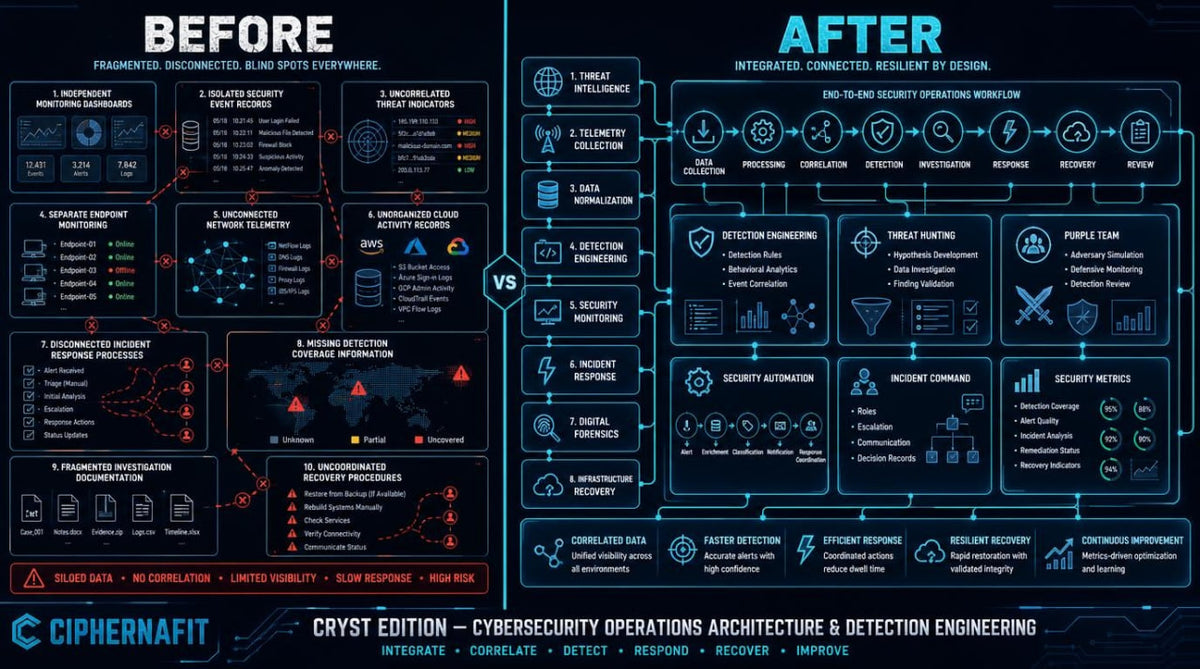
Complex digital infrastructures generate enormous volumes of technical events originating from network components, servers, applications, cloud environments, and identity systems. Even when individual monitoring mechanisms are present, organizations may struggle to correlate this information, identify hidden relationships, and recognize complex cyber threat scenarios. The absence of coordinated detection architecture, response automation, and defensive control evaluation complicates team coordination and systematic incident analysis.
2. Solution
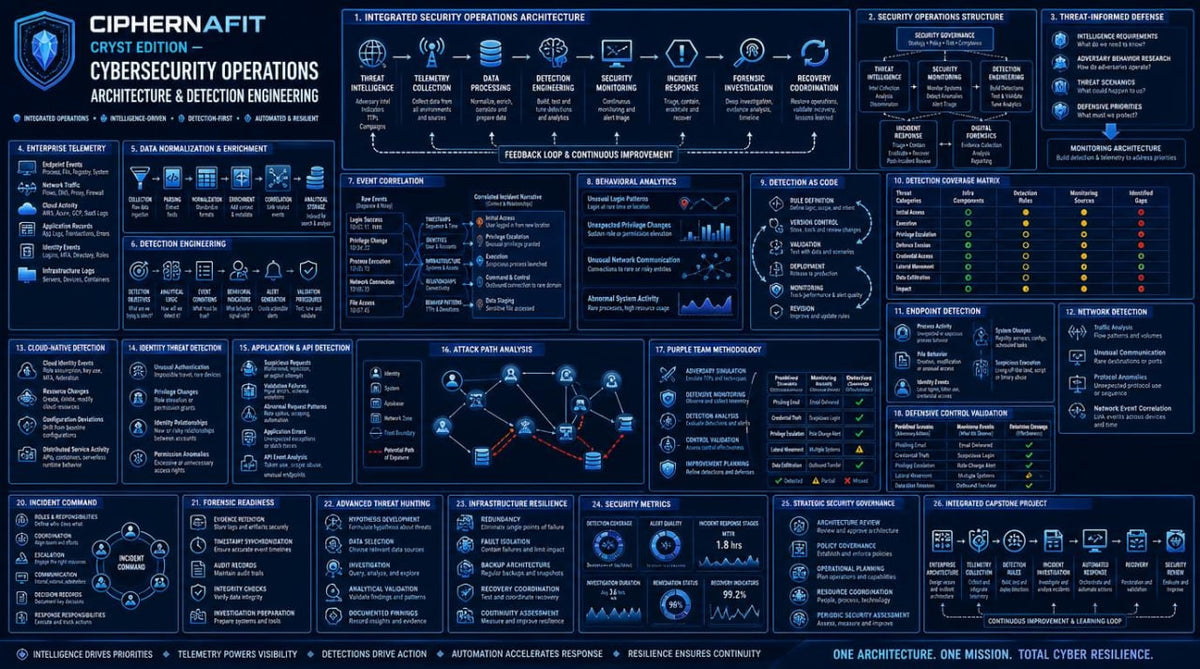
Cryst Edition presents an integrated methodology for developing cybersecurity operations in which telemetry collection, analytics, threat detection, and incident response function as interconnected processes. The learning materials examine detection engineering, event correlation, behavioral analytics, Threat Hunting, adversary simulation, and defensive operations automation. The final sections focus on complex incident management, defensive coverage assessment, architectural planning, and an integrated practical project.
3. What's Inside
-
Module 1: Integrated Cybersecurity Operations Architecture
-
Module 2: Security Operations Models and Organizational Structures
-
Module 3: Threat-Informed Defense and Intelligence Requirements
-
Module 4: Enterprise Security Telemetry Architecture
-
Module 5: Security Data Collection, Normalization and Enrichment
-
Module 6: Advanced Detection Engineering Fundamentals
-
Module 7: Detection Logic, Event Correlation and Behavioral Analytics
-
Module 8: Detection as Code and Rule Lifecycle Management
-
Module 9: Detection Coverage Mapping and Gap Analysis
-
Module 10: Endpoint Detection and Behavioral Monitoring
-
Module 11: Network Detection and Traffic Analytics
-
Module 12: Cloud-Native Threat Detection Architecture
-
Module 13: Identity Threat Detection and Privilege Analytics
-
Module 14: Application and API Threat Detection
-
Module 15: Attack Path Analysis and Exposure Prioritization
-
Module 16: Adversary Emulation and Purple Team Methodology
-
Module 17: Defensive Control Validation and Security Testing
-
Module 18: Security Automation and Response Orchestration
-
Module 19: Incident Command, Coordination and Escalation
-
Module 20: Forensic Readiness and Evidence Preservation
-
Module 21: Advanced Threat Hunting and Hypothesis Development
-
Module 22: Infrastructure Resilience and Recovery Coordination
-
Module 23: Security Metrics, Coverage and Operational Reporting
-
Module 24: Security Architecture Governance and Strategic Planning
-
Module 25: Integrated Cybersecurity Operations Capstone
4. Who Is This For?
Suitable if you:
✅ Already have advanced knowledge of cybersecurity, network architecture, digital forensics, or security testing.
✅ Are interested in designing comprehensive cybersecurity operations.
✅ Want to study the engineering of complex cyber threat detection systems.
✅ Intend to explore telemetry collection, normalization, and correlation architecture.
✅ Are interested in behavioral analytics and developing automated suspicious activity detection rules.
✅ Want to study Threat Hunting methodology and adversary behavior simulation.
✅ Intend to examine response automation and complex incident coordination.
✅ Are interested in Purple Team methodology and collaboration between testing and defensive teams.
✅ Want to investigate relationships between cloud, network, application, and identity security.
✅ Are looking for an extensive educational program combining technical analysis, architecture, and cybersecurity governance.
Not suitable if you:
❌ Do not yet have fundamental knowledge of computer networking and information security.
❌ Are looking for an introductory digital hygiene course.
❌ Expect exclusively theoretical materials without architectural and technical analysis.
❌ Are looking only for instructions on individual software tools.
❌ Do not intend to study complex technical concepts, system relationships, and multi-component incident scenarios.
5. What You'll Learn
After studying Cryst Edition, you will be able to:
-
Design the logical structure of integrated cybersecurity operations.
-
Analyze organizational models for information security teams.
-
Develop requirements for collecting cyber threat intelligence.
-
Design telemetry architecture for distributed digital infrastructure.
-
Understand technical data normalization, enrichment, and centralized analysis.
-
Develop suspicious activity detection logic based on technical indicators.
-
Analyze event correlation across different infrastructure components.
-
Understand behavioral analytics and unusual activity detection principles.
-
Create structured detection rules and manage their lifecycle.
-
Evaluate infrastructure coverage through threat detection mechanisms.
-
Analyze events across endpoints, networks, and cloud environments.
-
Investigate threats involving identity systems and privilege escalation.
-
Analyze suspicious activity within software applications and APIs.
-
Build attack path graphs and identify relationships between risks.
-
Develop controlled adversary behavior simulation scenarios.
-
Evaluate defensive mechanisms through controlled testing.
-
Design automated incident response processes.
-
Coordinate technical teams during complex security incidents.
-
Understand forensic readiness and digital investigation preparation.
-
Develop hypotheses for proactive investigation of hidden cyber threats.
-
Analyze infrastructure resilience and recovery processes following disruptions.
-
Establish metrics for evaluating cybersecurity operations.
-
Prepare analytical reports on defensive infrastructure conditions.
-
Develop architectural recommendations for improving cybersecurity operations.
-
Combine acquired knowledge through an integrated capstone project focused on designing a comprehensive cybersecurity operations architecture.
6. Refund Information
Refund conditions are determined by the current Ciphernafit Refund Policy. Before placing an order, we recommend reviewing the terms governing the purchase of digital learning materials, their delivery, and the applicable refund provisions.
Do I need previous cybersecurity knowledge to begin?
Do I need previous cybersecurity knowledge to begin?
No. Introductory courses are designed to introduce fundamental digital security concepts. Higher-level courses may require prior knowledge, as specified in their descriptions.
What is included in the learning materials?
What is included in the learning materials?
Each course has its own module structure, topic explanations, technical examples, and learning exercises where included in its curriculum. The complete list of materials is provided on the corresponding course page.
Can I study the materials at my own pace?
Can I study the materials at my own pace?
Yes. The learning materials are designed for independent study. You can revisit individual topics, take notes, and organize your study sessions according to your own schedule.
Share