Ciphernafit
Nexus Edition
Nexus Edition
Couldn't load pickup availability
- 📦 Digital file available after purchase
- 🔄 Long-term availability
- 🛡️ Secure checkout
- 🔄 Content updated in 2026
Self-paced learning overview
1. Problem Statement
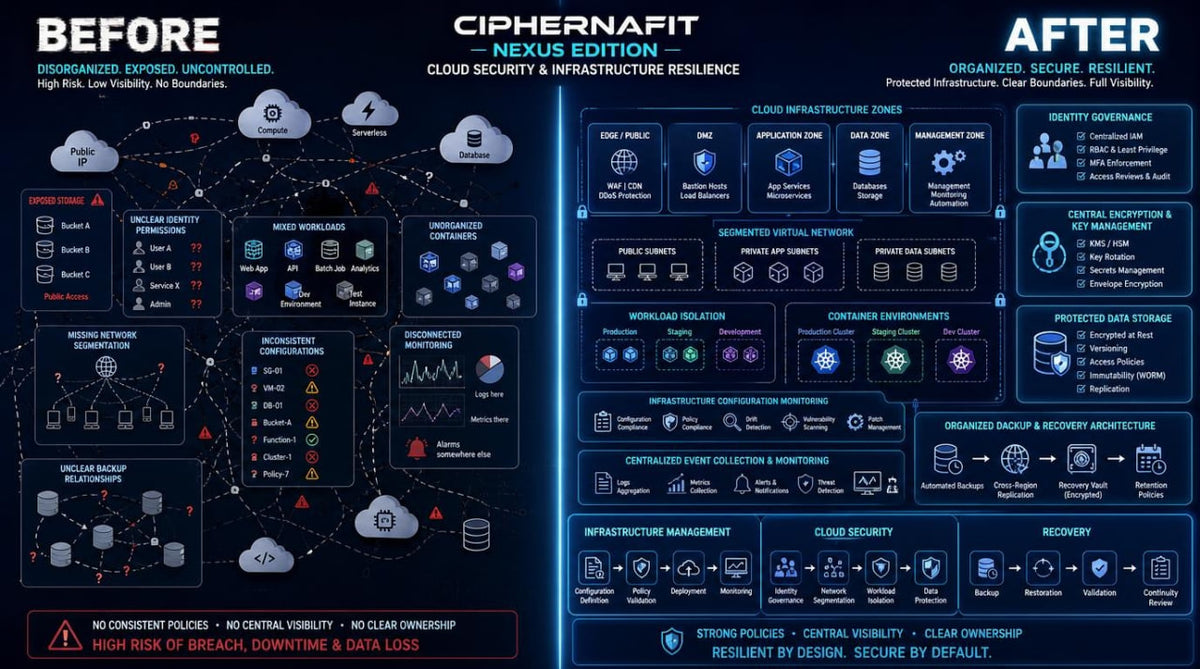
Modern cloud infrastructure consists of numerous interconnected components, distributed computing resources, data storage systems, and services with different security requirements. Inconsistent configuration management, excessive permissions, insufficient workload isolation, and poorly designed network interactions create complex risk scenarios. Additional challenges arise when controlling infrastructure changes, monitoring distributed systems, managing cryptographic keys, and restoring infrastructure following security incidents.
2. Solution
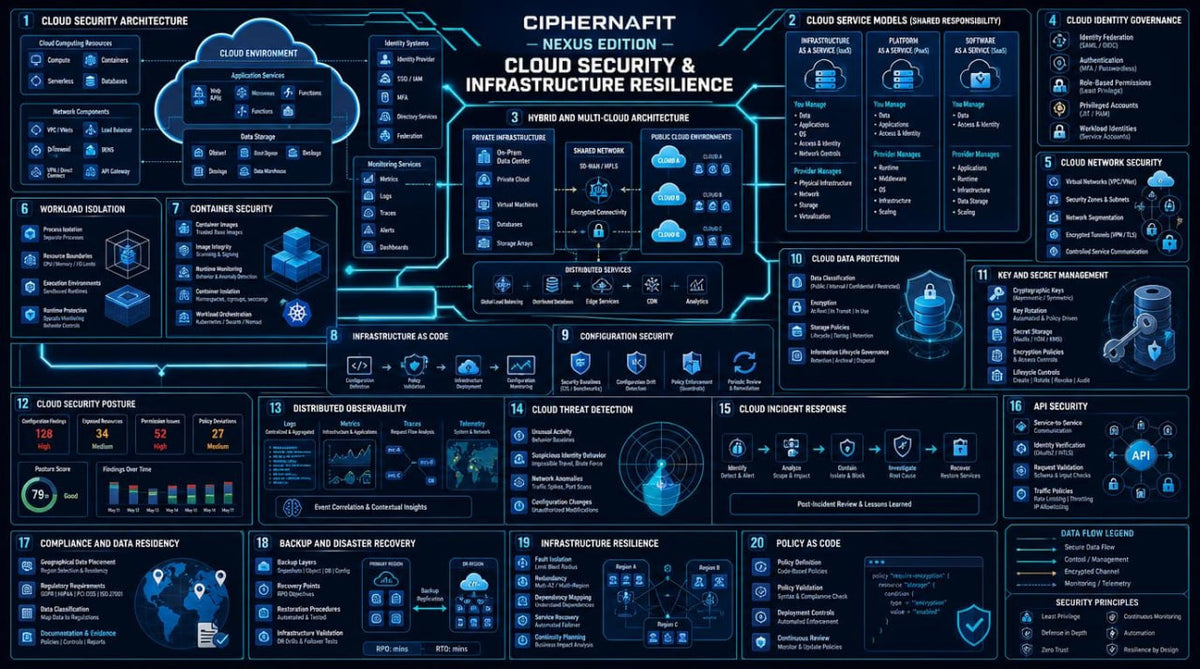
Nexus Edition presents a systematic approach to designing and protecting cloud infrastructure while considering the interaction between its technical and organizational components. The materials examine responsibility models, environment segmentation, identity governance, computing resource isolation, data protection, and automated security policy enforcement. Dedicated sections cover distributed system observability, cloud incident analysis, configuration management, and digital infrastructure recovery planning.
3. What's Inside
-
Module 1: Cloud Security Architecture Fundamentals
-
Module 2: Cloud Service Models and Shared Responsibility
-
Module 3: Multi-Cloud and Hybrid Infrastructure Design
-
Module 4: Cloud Identity and Permission Governance
-
Module 5: Cloud Network Segmentation and Connectivity
-
Module 6: Workload Isolation and Runtime Protection
-
Module 7: Container Security Architecture
-
Module 8: Orchestration Security and Workload Scheduling
-
Module 9: Infrastructure as Code Security
-
Module 10: Configuration Management and Security Baselines
-
Module 11: Cloud Data Classification and Protection
-
Module 12: Encryption, Key Lifecycle and Secret Management
-
Module 13: Storage Security and Data Lifecycle Governance
-
Module 14: Cloud Security Posture Management
-
Module 15: Cloud Logging and Distributed Observability
-
Module 16: Cloud Threat Detection and Event Correlation
-
Module 17: Cloud Incident Response and Investigation
-
Module 18: API Security in Distributed Environments
-
Module 19: Cloud Compliance and Data Residency
-
Module 20: Backup Architecture and Disaster Recovery
-
Module 21: Cloud Infrastructure Resilience Assessment
-
Module 22: Security Automation and Policy as Code
4. Who Is This For?
Suitable if you:
✅ Already have knowledge of network security, enterprise architecture, or secure software development.
✅ Are interested in protecting cloud and hybrid infrastructure.
✅ Want to study distributed computing environment architecture.
✅ Intend to explore identity governance, permission management, and workload isolation.
✅ Are interested in containerized environment security and computing resource orchestration.
✅ Want to understand Infrastructure as Code and automated security policy management.
✅ Work with technical infrastructure or study cloud system architecture.
✅ Are looking for comprehensive materials on cloud security, monitoring, and infrastructure recovery.
Not suitable if you:
❌ Are not yet familiar with network architecture and information security fundamentals.
❌ Are looking exclusively for an introductory course covering general digital device usage.
❌ Expect theoretical explanations without examining architectural and technical relationships.
❌ Are looking for materials focused exclusively on software development without infrastructure security topics.
❌ Require instructions for configuring specific commercial cloud services rather than studying universal protection principles.
5. What You'll Learn
After studying Nexus Edition, you will be able to:
-
Analyze cloud environment architecture and identify its main components.
-
Explain cloud service models and the distribution of security responsibilities.
-
Examine hybrid and multi-cloud environment architectures.
-
Design identity and permission governance logic.
-
Analyze network segmentation and interactions between cloud components.
-
Understand workload isolation and runtime environment protection.
-
Study the security architecture of containerized systems.
-
Understand orchestration protection and computing task scheduling principles.
-
Analyze risks associated with automated infrastructure definitions.
-
Establish fundamental configuration security requirements.
-
Classify cloud data according to sensitivity levels.
-
Understand cryptographic key lifecycles and confidential parameter management.
-
Analyze cloud storage protection and information lifecycle governance.
-
Examine cloud security posture assessment models.
-
Interpret event logs and distributed system telemetry.
-
Correlate events from different cloud infrastructure components.
-
Develop incident response sequences for cloud environments.
-
Analyze API security in distributed architectures.
-
Understand regulatory requirements governing data processing and residency.
-
Design backup and infrastructure recovery strategies.
-
Evaluate cloud architecture resilience against technical failures.
-
Examine automated security policy enforcement through the Policy as Code approach.
6. Refund Information
Refunds are governed by the current Ciphernafit Refund Policy. Before placing an order, we recommend reviewing the terms governing the purchase of digital learning materials, their delivery, and the applicable refund provisions.
Do I need previous cybersecurity knowledge to begin?
Do I need previous cybersecurity knowledge to begin?
No. Introductory courses are designed to introduce fundamental digital security concepts. Higher-level courses may require prior knowledge, as specified in their descriptions.
What is included in the learning materials?
What is included in the learning materials?
Each course has its own module structure, topic explanations, technical examples, and learning exercises where included in its curriculum. The complete list of materials is provided on the corresponding course page.
Can I study the materials at my own pace?
Can I study the materials at my own pace?
Yes. The learning materials are designed for independent study. You can revisit individual topics, take notes, and organize your study sessions according to your own schedule.
Share